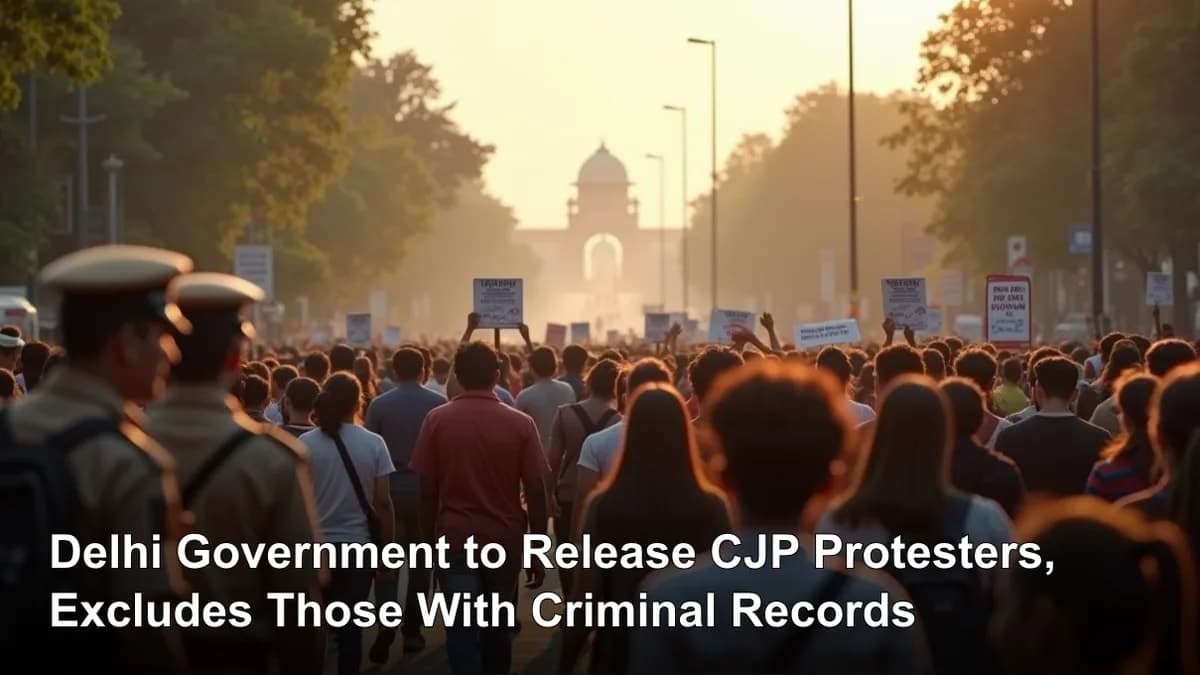
The Delhi government issued a notice on Thursday, July 30, confirming that no further legal action will be taken against individuals arrested during the recent protests over the alleged NEET question‑paper leak. The decision aligns with a Supreme Court directive issued on July 28 and a prior commitment made to the Cockroach Janta Party (CJP), the satirical political group that led the demonstrations.
According to the notice, the 13 cases filed by Delhi Police on July 29 will be reviewed, and all detainees without prior criminal records will be released. The government emphasized that any participant with a "criminal antecedent" will remain subject to prosecution, a clause that mirrors the Supreme Court's stipulation.
What Happened
Protests erupted on July 20 after students and activists alleged that the National Eligibility cum Entrance Test (NEET) question paper had been leaked. The CJP organized a march titled “Chalo Sansad” from the historic Jantar Mantar site, demanding the resignation of Education Minister Dharmendra Pradhan and the withdrawal of legal cases against demonstrators.
During the march, clashes broke out between protesters and Delhi Police. Video evidence, including CCTV footage, showed police deploying pellet guns and other crowd‑control measures. Law enforcement arrested dozens of participants and filed 13 criminal cases by the evening of July 29.
Public outcry over the alleged excessive force prompted the central government to intervene. The CJP’s primary demand—that the state drop all charges against protesters—was echoed by the Supreme Court, which on July 28 ordered all states to refrain from coercive action against demonstrators and to release those without prior convictions.
In response, Delhi Home Minister Ashish Sood issued a statement saying, “We stand with the students… Our government has honoured its commitment to them.” He added that any anti‑social elements with criminal histories would still face legal consequences.
Simultaneously, Parliament passed a bill amending the anti‑paper‑leak law, introducing penalties of up to ten years imprisonment and fines of up to ₹10 crore for future leaks. The legislation aims to deter similar scandals in the future.
Background
NEET, the entrance exam for undergraduate medical courses in India, has long been a flashpoint for student activism. In recent years, allegations of question‑paper leaks have sparked nationwide protests, reflecting broader concerns about fairness and transparency in the education system.
The Cockroach Janta Party, founded in 2022, employs satire and street theatre to highlight governance issues. Although not a mainstream political force, CJP’s ability to mobilize students gave it a prominent role in the July 20 demonstrations.
Timeline
July 20, 2026: CJP leads “Chalo Sansad” march from Jantar Mantar; clashes with police; arrests made.
July 28, 2026: Supreme Court orders states to release protesters without prior criminal records and to avoid coercive measures.
July 29, 2026: Delhi Police registers 13 criminal cases related to the protests.
July 30, 2026: Delhi Home Minister Ashish Sood announces that all detainees will be released, except those with criminal antecedents.
July 31, 2026: Lok Sabha passes amendment to anti‑paper‑leak law, increasing penalties.
Why It Matters
The decision to release most protesters signals a rare convergence of judicial, executive, and civil‑society pressures in India’s highly charged education sector. For students, the move is seen as a validation of their grievances and a reassurance that peaceful dissent will not be criminalized.
For the Delhi administration, the announcement serves to defuse a volatile situation while preserving law‑and‑order credibility. By excluding individuals with prior criminal records, the government attempts to balance public safety concerns with the Supreme Court’s humanitarian directive.
The amendment to the anti‑paper‑leak law also carries weight. By imposing harsher punishments, lawmakers aim to deter future leaks, which have repeatedly undermined confidence in competitive exams. However, critics warn that the punitive approach may not address the systemic vulnerabilities that enable leaks.
Industry Impact
Education‑technology firms and coaching institutes that prepare students for NEET will closely monitor the legal developments. Stricter penalties could lead to increased investment in secure exam‑paper handling and digital monitoring, potentially reshaping the industry’s compliance landscape.
Politically, the episode underscores the growing influence of unconventional protest groups like the CJP. Their ability to force policy concessions, even on a satirical platform, may encourage other activist collectives to adopt similar tactics.
Key Takeaways
Delhi will release all protesters from the July 20 NEET leak demonstrations, except those with prior criminal records.
The move follows a July 28 Supreme Court order that barred coercive action against demonstrators without criminal antecedents.
Thirteen criminal cases filed by Delhi Police will be reviewed, and the matter is declared closed.
Parliament passed an amendment to the anti‑paper‑leak law, raising penalties to ten years imprisonment and ₹10 crore fines.
The Cockroach Janta Party’s demands, including the resignation of Education Minister Dharmendra Pradhan, remain partially unmet.
The episode highlights the delicate balance between maintaining public order and protecting the right to peaceful protest in India.
Conclusion
As the Delhi government proceeds with the release of detainees, attention will shift to the implementation of the new anti‑paper‑leak provisions and the broader reform agenda for India’s entrance‑exam system. Observers will also watch whether the CJP escalates its campaign or redirects its focus toward other governance issues.
Future court rulings and parliamentary debates will determine whether the current conciliatory approach becomes a template for handling student‑led movements across the country.