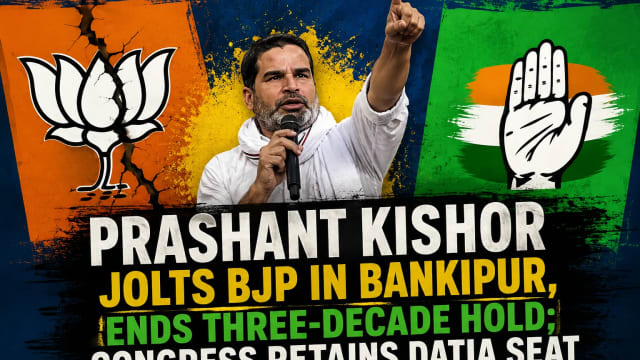
On August 3, 2026, India’s Election Commission declared the results of three high‑profile assembly by‑elections that produced mixed outcomes for the ruling Bharatiya Janata Party (BJP). In Bihar’s Bankipur constituency, political strategist‑turned‑candidate Prashant Kishor, founder of the Jan Suraaj party, defeated the BJP’s Neeraj Kumar by 19,324 votes after 31 rounds of counting. In Madhya Pradesh, the Congress party held onto the Datia seat, while in Gujarat the BJP retained its stronghold in Manjalpur.
The three contests were held on July 30, 2026, and attracted a combined voter turnout of 71.44 percent. The Bankipur victory marks Jan Suraaj’s first ever win in an assembly poll and represents a rare breach of a BJP bastion that had been held by national president Nitin Nabin until his resignation earlier this year. Analysts say the outcomes may reflect a broader disenchantment among Hindi‑heartland voters, especially after recent student protests and the resignation of Union Education Minister Dharmendra Pradhan.
What Happened
In Bankipur, Kishor secured a decisive margin of 19,324 votes over BJP rival Neeraj Kumar. The seat, long regarded as a BJP stronghold, became vacant after Nitin Nabin resigned to take up a Rajya Sabha seat in April 2026. Kishor’s victory not only gave Jan Suraaj its inaugural assembly win but also underscored the appeal of a new political brand that had failed to win any of the 238 seats it contested in the November 2025 Bihar assembly election.
Across the state line in Datia, Madhya Pradesh, Congress candidate Ghanshyam Singh defeated BJP’s Ashutosh Tiwari by a little over 6,000 votes after 15 rounds of counting. The by‑poll was triggered when a Delhi court sentenced Congress MLA Rajendra Bharti to three years in prison for a cheating case, resulting in the vacancy. Voter turnout in Datia mirrored the state average, and the result was seen as a prestige test for both parties amid a backdrop of student unrest and the recent resignation of education minister Dharmendra Pradhan.
Manjalpur in Gujarat saw the BJP comfortably retain the seat. Satish Patel, a former Vadodara municipal councillor, amassed 55,481 votes, outpacing Congress veteran Bhikhabhai Rabari, who received 24,851 votes. The margin of 30,630 votes, recorded after 20 rounds of counting, reinforced the constituency’s status as a BJP stronghold. This by‑poll was necessitated by the death of senior BJP MLA and former minister Yogesh Patel.
Violence erupted in Datia on July 11, when supporters of senior BJP leader Narottam Mishra, denied a ticket for the upcoming by‑poll, clashed with police, blocking National Highway 44 for nearly 12 hours. Over 3,000 protesters were involved, and several police officers were injured before security forces cleared the road and made arrests.
Background
Jan Suraaj entered the political arena in 2024, positioning itself as a youth‑focused alternative to the two‑party system. In the November 2025 Bihar assembly election, the party contested 238 seats but failed to win any, prompting a strategic pivot toward targeted by‑polls. Prashant Kishor, previously known for his role as a chief strategist for multiple state governments, launched his own electoral campaign in Bankipur, a constituency that had been under BJP control for decades.
The Bankipur seat became vacant after Nitin Nabin, the BJP’s national president, was elected to the Rajya Sabha in April 2026. His departure opened a rare opening for opposition forces in a region where the BJP has traditionally commanded overwhelming support. Similarly, the Datia seat’s vacancy stemmed from a criminal conviction of a sitting Congress MLA, adding a legal dimension to the political contest.
Why It Matters
Kishor’s win in Bankipur signals that a new political formation can break through entrenched BJP territory, especially when leveraging discontent among younger voters. The victory is especially notable given the party’s previous electoral setbacks, suggesting a possible recalibration of voter preferences in Bihar’s capital region.
In Madhya Pradesh, the Congress retention of Datia, despite the BJP’s overall dominance in the state, provides the opposition with a morale boost ahead of the 2028 assembly elections. Analysts argue that the result reflects a “level of disillusionment” among BJP voters, potentially linked to recent student protests over educational policies and the resignation of Education Minister Dharmendra Pradhan.
The Manjalpur result, while expected, reinforces the BJP’s continued grip on Gujarat, a state that has been a cornerstone of the party’s national strategy. However, the margin of victory, though large, does not offset the symbolic losses in the Hindi heartland and may prompt the BJP to reassess its outreach to younger demographics.
Industry Impact
The by‑poll outcomes could influence how political parties allocate resources and craft messaging ahead of the 2028 state elections. Jan Suraaj’s breakthrough may encourage other nascent parties to focus on constituency‑specific campaigns rather than broad statewide sweeps. For the BJP, the mixed results may trigger a strategic review of candidate selection, especially in constituencies where internal dissent, such as the Narottam Mishra ticket denial, has already sparked unrest.
Key Takeaways
Prashant Kishor’s Jan Suraaj wins Bankipur, marking its first assembly victory.
Congress retains Datia, signaling potential voter fatigue with the BJP in the Hindi heartland.
BJP holds Manjalpur, maintaining its dominance in Gujarat.
Student protests and the education minister’s resignation appear to have reshaped voter sentiment.
Internal BJP disputes, exemplified by the Narottam Mishra ticket denial, led to violence in Datia.
The results may foreshadow shifting dynamics ahead of the 2028 state elections.
Conclusion
As India moves toward the 2028 assembly elections, the August 2026 by‑polls offer a snapshot of evolving political currents. While the BJP retains its stronghold in Gujarat, losses in Bihar and Madhya Pradesh suggest that youth‑led movements and internal party fissures could erode the saffron party’s traditional base. Observers will watch closely how Jan Suraaj leverages its Bankipur win and whether the Congress can translate its Datia success into broader gains.
Future developments, including the BJP’s response to the perceived “disillusionment” among Hindi‑heartland voters and the potential rise of other regional outfits, will shape the political landscape in the coming years.