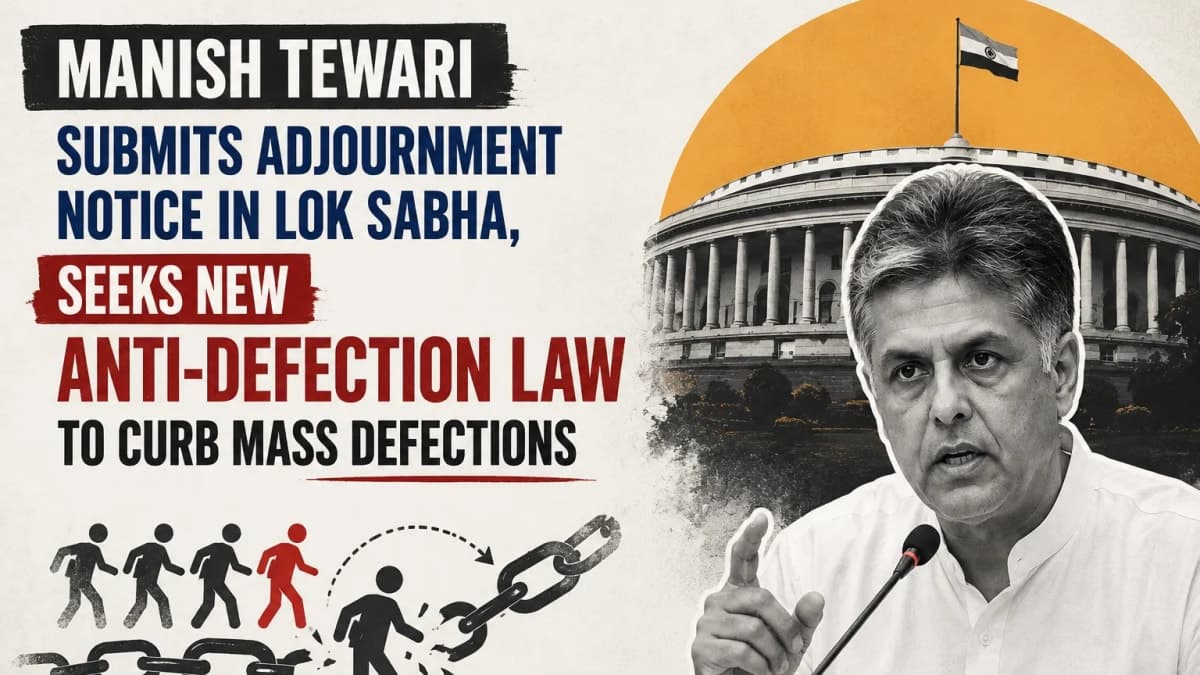
Manish Tewari Seeks Lok Sabha Discussion on Anti-Defection Law
Congress MP Manish Tewari has submitted an adjournment notice in the Lok Sabha seeking a discussion on introducing a new anti-defection law to address opportunistic mass defections.
The notice puts the issue of political defections back in focus and seeks parliamentary attention on whether India's current legal framework is adequate to deal with situations in which groups of elected representatives change political allegiance.
Anti-Defection Framework Back in Focus
India already has an anti-defection mechanism under the Tenth Schedule of the Constitution. It was introduced to discourage elected legislators from changing parties in ways that could undermine political stability and the mandate delivered by voters.
Over the years, however, political defections have continued to generate debate, particularly when several legislators shift allegiance together or when changes in party strength have implications for governments and legislative majorities.
Tewari's notice seeks a discussion specifically around the need for a new law capable of curbing opportunistic mass defections.
Why the Issue Matters
Defection is more than an internal matter for political parties because elected representatives receive their mandate from voters. When lawmakers change political allegiance after an election, questions can emerge over whether such a move respects the electoral mandate.
At the same time, any debate on strengthening anti-defection rules also has to consider the independence of legislators. A stringent framework can discourage politically motivated defections, but it can also raise concerns about how much freedom elected representatives should have to disagree with their parties.
That balance between political stability, party discipline and legislative independence remains central to the broader anti-defection debate.
Parliament Could Become Key Forum for Debate
By submitting an adjournment notice, Tewari has sought to bring the subject before the Lok Sabha for discussion. The proposal highlights concerns about mass defections and whether additional legislative safeguards are necessary.
A parliamentary debate, if taken up, could provide lawmakers an opportunity to examine the effectiveness of the existing system and discuss whether changes are required to address contemporary forms of political defection.
Balanced Analysis
Supporters of stronger anti-defection provisions may argue that tougher rules are necessary to protect electoral mandates and discourage lawmakers from changing political sides for strategic or personal advantage.
Others may caution that excessively restrictive rules could further strengthen political parties at the expense of individual legislators, limiting their ability to vote according to their judgment or represent disagreements within their constituencies.
The broader challenge, therefore, is to develop rules that discourage opportunistic political switching without eliminating legitimate dissent within India's parliamentary system.