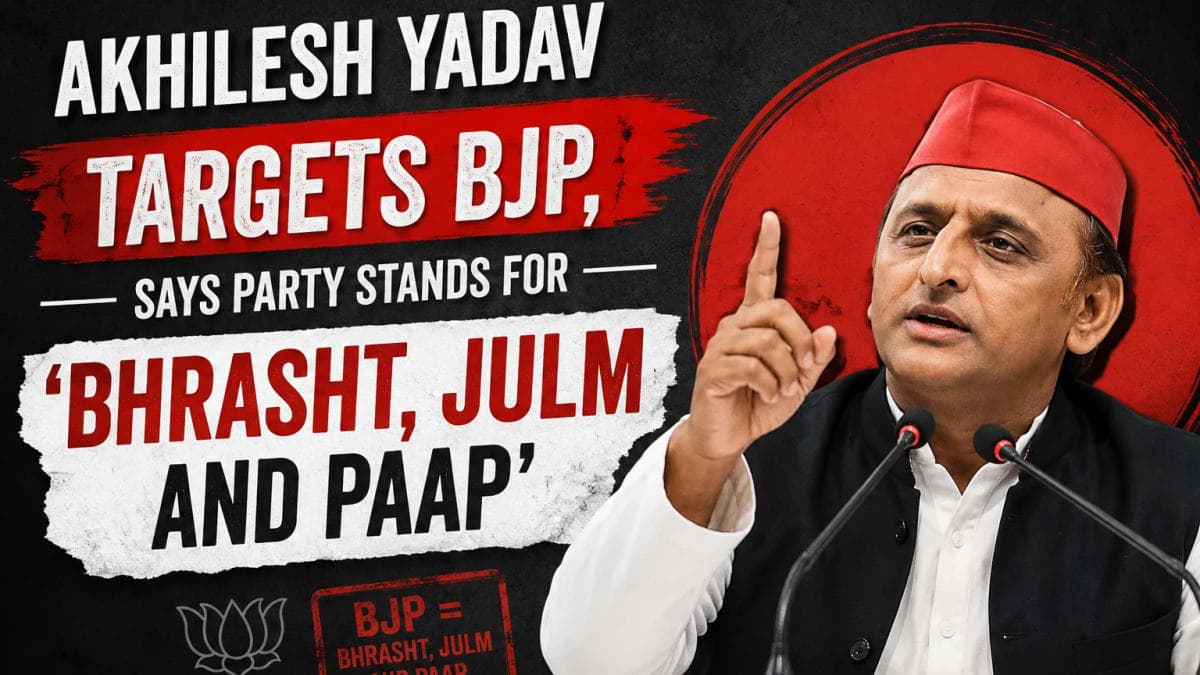
Samajwadi Party president Akhilesh Yadav has stepped up his criticism of the Bharatiya Janata Party, describing the BJP through a pointed reinterpretation of its initials.
Yadav said BJP stood for “bhrasht”, “julm” and “paap”, terms that broadly translate to corruption, oppression and sin. The statement represents a strongly worded political attack on the ruling party and reflects the confrontational language frequently seen between political rivals.
Akhilesh Yadav Sharpens Attack on BJP
As president of the Samajwadi Party, Akhilesh Yadav is one of the BJP’s prominent political opponents, particularly in Uttar Pradesh.
His latest remark uses wordplay as a political messaging device, turning the BJP abbreviation into a criticism of the party. Such short and memorable expressions are often used by political leaders to communicate broader accusations to supporters and attract public attention.
The statement itself is political rhetoric and should not be interpreted as independently established evidence of corruption, oppression or wrongdoing by the BJP.
Why the Remark Matters
The comment is significant because it illustrates the intensity of political competition between the Samajwadi Party and the BJP.
The BJP and the Samajwadi Party represent competing political forces, and their leaders regularly challenge each other over governance, public policy and political performance. Yadav’s latest statement continues that broader political confrontation.
Sharp slogans can also play an important role in election-oriented communication because they compress a political argument into language that is easy to repeat at public meetings, in television debates and across social media.
Political Messaging Through Wordplay
Indian political discourse has a long history of leaders using slogans, acronyms and wordplay to criticise opponents or reinforce campaign narratives.
Yadav’s interpretation of “BJP” follows this familiar approach. Rather than presenting a detailed policy argument in the quoted remark, the Samajwadi Party leader uses three strongly negative terms to convey his criticism.
The political effectiveness of such messaging ultimately depends on whether voters connect the slogan with their own assessment of governance and political conditions.
Balanced Perspective
Yadav’s remark should be understood as a partisan political statement from the leader of an opposition party. The words “bhrasht”, “julm” and “paap” express his political characterization of the BJP rather than independently verified findings.
Without additional facts about the circumstances surrounding the statement or a response from the BJP, conclusions about the wider controversy would be premature.
The episode nevertheless demonstrates how political communication is increasingly shaped by concise, provocative phrases designed to capture public attention and strengthen competing narratives.
Conclusion
Akhilesh Yadav’s claim that BJP stands for “bhrasht”, “julm” and “paap” marks another sharp attack by the Samajwadi Party president on his political rival.
While the statement is rhetorical rather than a detailed allegation supported by evidence in the information provided, its wording highlights the continuing intensity of the political contest between the Samajwadi Party and the BJP.