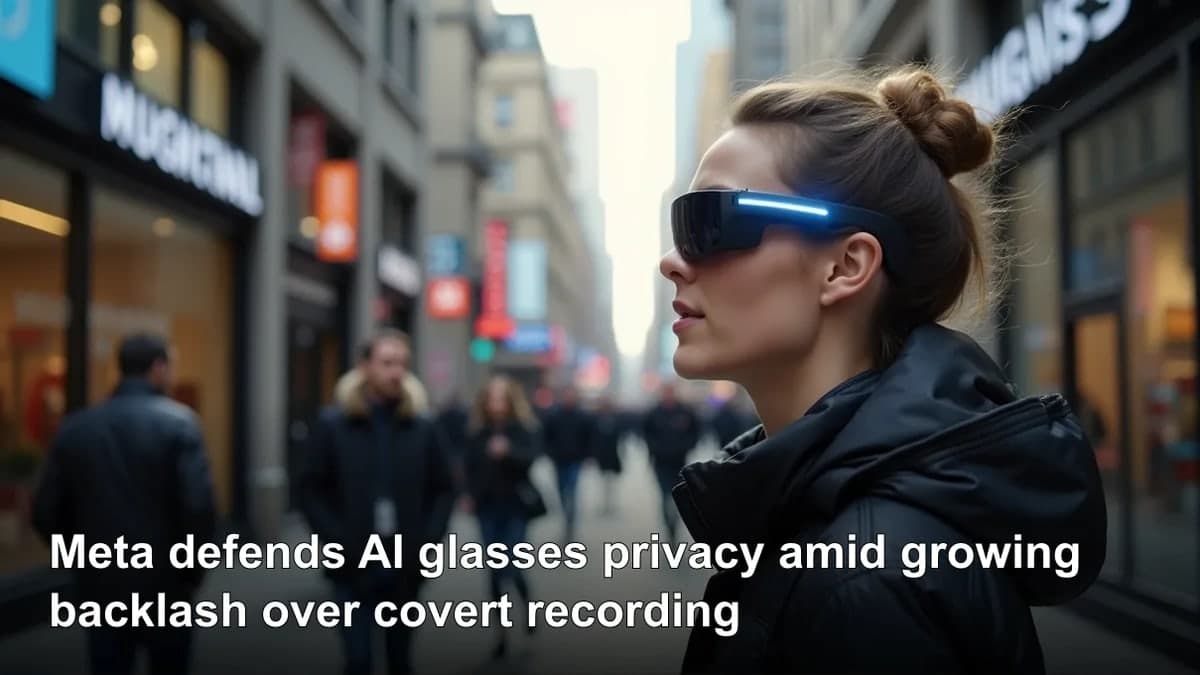
Meta on Tuesday reiterated its commitment to privacy safeguards built into its AI‑powered smart glasses, a device that has sparked mounting public concern over the ability to record video without consent. In a blog post dated July 7, the company outlined technical measures such as a blinking white LED on the frame and an audible shutter sound intended to alert bystanders when the glasses are capturing footage. Meta also warned that attempts to conceal the indicator could trigger an automatic camera shutdown.
The announcement comes after a Swedish media investigation revealed that contract workers in Kenya had accessed highly personal, including sexual, recordings made with the glasses. The leak has intensified calls from privacy advocates and lawmakers for clearer regulations governing wearable cameras in public and sensitive spaces.
What Happened
Meta’s July 7 blog post detailed three primary privacy‑related features of its second‑generation AI glasses. First, a white LED, dubbed the “capture LED,” blinks on the frame whenever the camera is active. Second, a shutter‑type sound is emitted at the start of each recording. The company conceded that the sound may not be audible at a distance, acknowledging a limitation of the audible cue.
Third, Meta introduced a detection system that senses when the LED is obstructed. If the system determines that the light is blocked—whether by tape, stickers, or more sophisticated modifications—the camera is automatically disabled and no photo or video can be taken. Meta said it has already observed users attempting both simple and elaborate methods to conceal the LED, prompting the safeguard.
In addition to technical controls, Meta announced enforcement actions against sellers and users who tamper with the glasses. The company said it would remove advertisements, posts, and product listings that promote or facilitate the use of modified devices, and it would ban accounts that violate the policy. Meta also indicated that it is prepared to pursue legal remedies against vendors distributing non‑compliant hardware.
Meta juxtaposed its approach with existing consumer electronics, noting that smartphones and action cameras lack a dedicated visual indicator for active recording. The comparison was intended to frame the LED as an industry‑leading privacy feature, rather than an optional add‑on.
Background
Meta first unveiled its AI glasses prototype in late 2024, positioning the wearable as a hands‑free conduit for augmented reality (AR) experiences powered by the company’s large‑language models. Early adopters praised the device’s ability to overlay contextual information onto the real world, but privacy concerns emerged almost immediately. Critics argued that a discreet camera could be used to capture unsuspecting subjects in public, workplaces, or private settings.
In early 2025, a series of viral videos showed users pointing the glasses at strangers without their knowledge, prompting social media backlash and petitions demanding transparency. By mid‑2025, several municipalities in Europe and North America began exploring ordinances that would require visible recording indicators on wearable cameras.
Timeline
Late 2024 – Meta releases first‑generation AI glasses prototype.
Early 2025 – Public criticism grows after viral recordings surface.
June 2025 – European city councils debate “wearable camera” regulations.
July 7, 2026 – Meta publishes blog post outlining capture LED, sound, and LED‑block detection.
July 9, 2026 – Swedish outlets report Kenyan contract workers viewing private footage.
July 31, 2026 – The Hindu publishes article on Meta’s privacy response.
Why It Matters
The privacy implications of AI glasses extend beyond individual discomfort. When a device can record high‑definition video and stream it to cloud‑based AI models, the potential for mass surveillance rises sharply. Unconsented recordings could be harvested for advertising, facial‑recognition databases, or even black‑mail, especially if the footage contains intimate content.
For users, the presence of a visible LED offers a tangible cue that recording is occurring, potentially reducing the risk of accidental privacy violations. However, the fact that Meta admits the sound cue may be inaudible at a distance suggests that visual indicators remain the primary safeguard.
The Kenyan worker incident underscores a supply‑chain risk: footage stored on Meta’s servers can be accessed by third‑party contractors, raising questions about data handling, employee training, and cross‑border privacy standards. The exposure of sexual content amplified calls for stricter oversight of how AI‑generated media is stored and reviewed.
Regulators are watching closely. In the United States, the Federal Trade Commission has signaled interest in drafting guidance for “always‑on” cameras, while the European Union’s Digital Services Act already requires platforms to mitigate systemic risks, including privacy harms.
Industry Impact
Meta’s public stance may set a de‑facto benchmark for other manufacturers of wearable AR devices. Competitors such as Apple, Google, and Snap have yet to disclose comparable LED‑based safeguards, and industry analysts predict that consumer demand for transparent recording cues could become a differentiator in the emerging AR market.
From a regulatory perspective, Meta’s proactive measures could be used by lawmakers as a reference point when drafting legislation. The company’s willingness to remove tampered‑product listings and pursue legal action signals an intent to cooperate with authorities, potentially easing the path toward broader acceptance of AR wearables.
Key Takeaways
Meta’s AI glasses now feature a blinking capture LED and shutter sound to signal recording.
Automatic camera shutdown activates if the LED is blocked, preventing covert capture.
The company will remove ads and listings for tampered devices and may pursue legal action against sellers.
A Swedish investigation revealed Kenyan contract workers viewing private footage, heightening privacy concerns.
Regulators in the U.S. and EU are considering rules that could mandate visible indicators on wearable cameras.
Meta’s approach may influence industry standards for privacy in AR wearables.
Conclusion
Meta’s latest privacy assurances aim to balance the commercial promise of AI‑enhanced glasses with growing public unease over covert recording. As lawmakers deliberate on wearable‑camera regulations and as supply‑chain scrutiny intensifies, the company’s technical safeguards and enforcement policies will likely be tested in courts and markets alike.
Stakeholders should monitor upcoming policy proposals in the United States and Europe, as well as any further disclosures from Meta regarding data handling practices for recorded content. The evolution of privacy standards for AR wearables will shape both consumer adoption and the competitive landscape for the next generation of smart glasses.