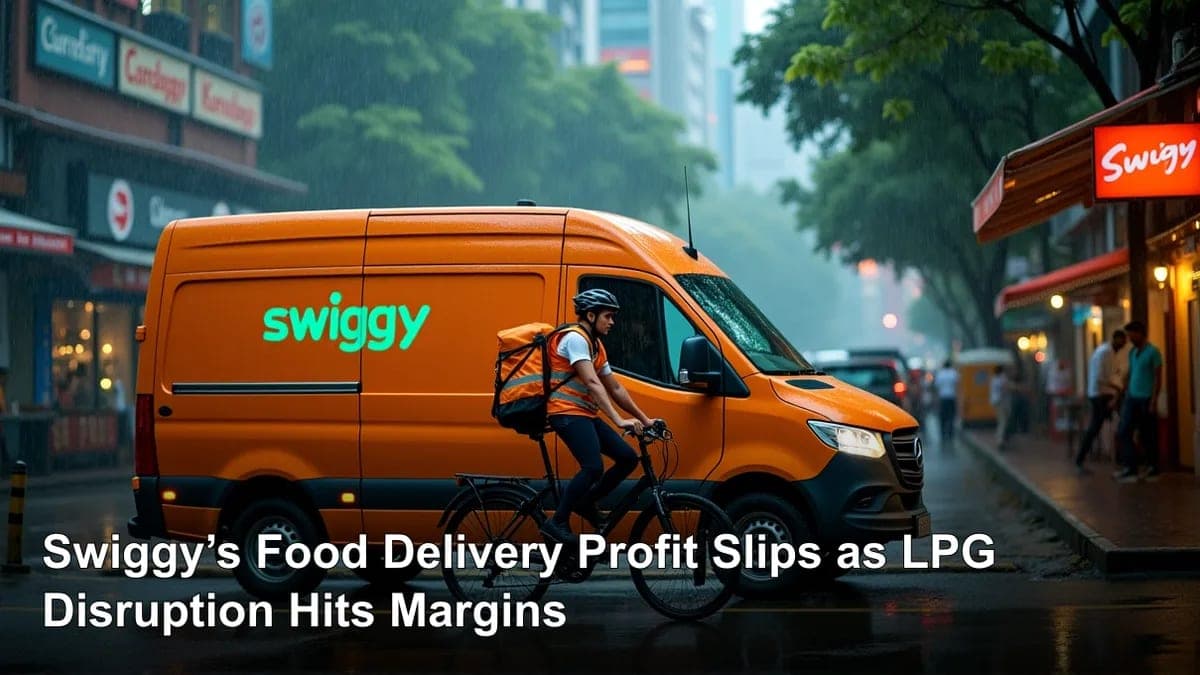
Swiggy’s food‑delivery arm reported a modest profit dip in the first quarter of fiscal 2027, with segment earnings falling 2.3% quarter‑on‑quarter to ₹299 Cr. The decline came despite a 22.7% year‑over‑year jump in revenue to ₹2,208 Cr, underscoring the impact of supply chain shocks and seasonal headwinds on margins.
Earlier this month, the company disclosed that an LPG supply disruption early in the quarter forced many partner restaurants to cancel orders, eroding gross order value (GOV) growth. Combined with the monsoon‑induced slowdown and annual salary revisions, Swiggy’s adjusted EBITDA margin slipped to 3.1% of GOV, 20 basis points lower than the previous quarter.
Despite the profit setback, Swiggy maintained its medium‑term target of a 5% adjusted EBITDA margin on GOV and continued to grow its user base, adding 0.9 million monthly transacting users to reach 19.2 million. The company also expanded its affordability‑focused Toing app, now live in 50 cities, as part of its strategy to capture cost‑conscious consumers.
What Happened
Swiggy’s food‑delivery revenue rose 6.5% sequentially from ₹2,073 Cr in Q4 FY26 to ₹2,208 Cr in Q1 FY27, while gross order value climbed 17.4% YoY to ₹9,490 Cr. The company noted that, after adjusting for restaurant‑driven cancellations caused by the LPG disruption, GOV growth would have been close to 18%.
Profitability, however, slipped: segment profit fell from ₹306 Cr to ₹299 Cr, a 2.3% quarter‑on‑quarter decline. Adjusted EBITDA fell to ₹292 Cr, down ₹5 Cr from the prior quarter, reflecting higher delivery‑partner investments and wage hikes that accompanied the annual salary review cycle.
The company’s adjusted EBITDA margin dropped to 3.1% of GOV, a 20‑basis‑point slide, while the contribution margin also fell by 20 basis points. Swiggy reiterated its guidance of 18‑20% GOV growth, excluding its Toing platform, citing healthy user additions and higher basket values as sustaining demand.
In the broader context, Swiggy’s Toing app, launched in 50 cities, targets budget‑conscious diners. The platform claims that two of every three new users are either first‑time or dormant, helping restaurants generate incremental orders without additional infrastructure investment.
Background
Swiggy, India’s leading food‑delivery service, has built a vast restaurant network and logistics infrastructure, enabling it to launch multiple formats such as Bolt, One BLCK, Eat Right, 99 Store and Toing. The company has repeatedly highlighted its ability to maintain economics that new entrants struggle to replicate.
Earlier this year, Swiggy faced a supply‑chain shock when a nationwide LPG shortage forced partner restaurants to cancel orders, a disruption that rippled through the food‑delivery ecosystem. The company estimated that the cancellation wave would have reduced GOV growth by roughly 0.6%.
Why It Matters
For users, the LPG shortage translated into fewer available dishes during peak hours, potentially affecting order volume and delivery times. Restaurants faced revenue dips, while delivery partners encountered reduced earnings due to cancellations and higher operational costs.
From a market perspective, Swiggy’s margin contraction signals the fragility of high‑volume, low‑margin business models in the face of supply‑chain volatility. The company’s continued investment in delivery‑partner incentives and wage hikes highlights the cost pressures that can erode profitability even amid revenue growth.
Swiggy’s expansion of the Toing app reflects a broader industry trend toward segmented offerings aimed at capturing price‑sensitive segments without diluting core margins. The strategy also underscores the importance of platform scalability and cost‑efficient logistics in sustaining long‑term growth.
Industry Impact
The food‑delivery sector is witnessing intensified competition, with new entrants such as Rapido’s Ownly and Flipkart’s upcoming service eyeing market share. Swiggy counters by emphasizing its entrenched restaurant network, technology stack, and logistics reach as barriers to entry.
Swiggy’s critique of zero‑commission models—arguing that platform costs must ultimately be borne by restaurants, consumers or delivery partners—highlights the sustainability debate around fee structures. The company’s stance suggests that any new entrant must offer a distinct value proposition to overcome established economies of scale.
Key Takeaways
Swiggy’s Q1 FY27 food‑delivery profit fell 2.3% QoQ amid LPG supply disruptions and monsoon softness.
Revenue rose 22.7% YoY to ₹2,208 Cr, driven by a 6.5% sequential increase and 17.4% GOV growth.
Adjusted EBITDA margin slipped to 3.1% of GOV, reflecting higher delivery‑partner wages and investment.
The company added 0.9 million monthly transacting users, reaching 19.2 million in total.
Swiggy’s Toing app is expanding to 50 cities, targeting budget‑conscious diners and boosting restaurant order volumes.
Industry competition intensifies, but Swiggy’s network and logistics infrastructure remain key competitive advantages.
Conclusion
Swiggy’s first‑quarter results illustrate the delicate balance between revenue growth and margin preservation in a highly competitive and supply‑chain‑sensitive market. While the company’s profitability slipped, its strategic focus on affordability, network scale, and cost‑efficient logistics positions it to navigate future disruptions.
Investors and analysts will likely monitor how Swiggy manages wage pressures, delivery‑partner incentives, and the performance of its Toing platform as it seeks to achieve its 5% adjusted EBITDA margin target in the medium term.