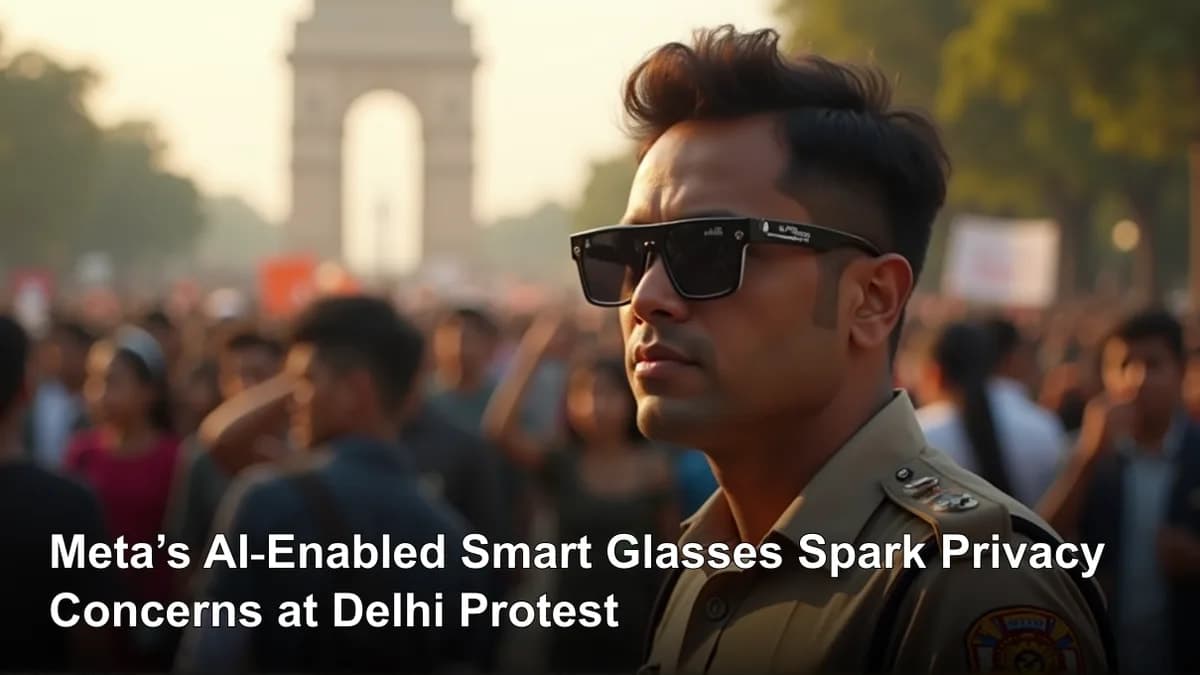
On July 31, 2026, observers at a protest organized by the Cockroach Janta Party (CJP) in Delhi reported that a police official appeared to be wearing a pair of smart glasses capable of recording video and taking photos without obvious signs. The incident, captured by on‑site witnesses and reported in local media, has reignited a broader conversation about the use of artificial‑intelligence (AI) enabled wearable devices for law‑enforcement surveillance, and the potential erosion of civilian privacy in public spaces.
The glasses, produced by Meta Platforms Inc., integrate a miniature camera, microphone and an AI‑driven virtual assistant that can be activated by voice command. According to eyewitnesses, the officer simply asked the assistant to record, and the device began capturing footage of the crowd – a group largely composed of university students – without any visible indicator. The episode unfolded amid a dense deployment of AI‑powered security cameras already installed around Jantar Mantar, the historic protest site in New Delhi.
What Happened
During the CJP demonstration, which drew several hundred participants, a Delhi Police officer on duty was spotted wearing a sleek pair of smart glasses. The device, similar in appearance to ordinary eyewear, houses a discreet camera that can be triggered by a spoken command to the built‑in AI assistant. Witnesses said the officer asked the assistant to start recording, and the glasses began streaming video directly to a handheld device, presumably for real‑time analysis.
Protesters, accustomed to overt surveillance from fixed cameras, were reportedly unaware that a point‑of‑view (PoV) device was being used. The unobtrusive nature of the glasses meant that the act of recording could go unnoticed, raising concerns that individuals could be filmed without consent or knowledge, even in a public protest where the expectation of privacy is already limited.
Local media highlighted the incident as an example of “covert” surveillance, noting that while the police officer’s use of the technology may be legal under existing statutes, it blurs the line between transparent public security measures and hidden data collection. The story quickly spread on social platforms, prompting calls for clarification from both the Delhi Police and Meta.
Background
Meta entered the wearable market in 2023 with a line of AI‑enhanced smart glasses that combine augmented‑reality overlays, voice‑activated assistants, and built‑in cameras. The company has positioned the product as a “hands‑free” tool for content creators, professionals, and, increasingly, security personnel. While Meta’s glasses have been marketed primarily for consumer use, several law‑enforcement agencies worldwide have explored their potential for rapid situational awareness and evidence gathering.
In India, the adoption of AI‑driven surveillance technologies accelerated after the 2020 amendment to the Information Technology Act, which expanded the government’s authority to deploy facial‑recognition and video analytics in public spaces. By 2025, major Indian cities, including Delhi, had installed thousands of AI‑enabled security cameras capable of real‑time crowd monitoring, license‑plate reading, and behavior analysis.
Timeline
2023 – Meta launches its first generation of AI‑powered smart glasses.
2024 – Indian police forces begin pilot programs testing wearable cameras for traffic enforcement.
2025 – Delhi installs a network of AI surveillance cameras around key protest sites, including Jantar Mantar.
July 2026 – A Delhi police officer is observed using Meta’s smart glasses during the CJP protest.
Why It Matters
The incident raises immediate questions about consent, data protection, and the balance between security and civil liberties. In India, the Supreme Court’s 2017 ruling affirmed privacy as a fundamental right, yet the country’s Personal Data Protection Bill, still under parliamentary debate, has yet to provide clear guidance on the use of wearable recording devices by state actors.
From a practical standpoint, covert recording can capture images of individuals who have not opted into surveillance, potentially storing biometric data such as facial features without explicit authorization. This data could be combined with existing city‑wide camera feeds, creating a more detailed profile of protest participants and amplifying the risk of misuse.
Human‑rights groups argue that the presence of undisclosed recording devices may have a chilling effect on free expression, discouraging citizens from assembling or voicing dissent. Conversely, law‑enforcement officials contend that wearable AI tools improve officer safety and evidence collection, especially in dynamic, crowded environments where fixed cameras may have blind spots.
Industry Impact
Meta’s foray into law‑enforcement applications could open a new revenue stream for the company, but it also exposes the firm to heightened scrutiny. If regulators tighten rules around covert surveillance, Meta may need to embed additional safeguards—such as audible alerts or visible recording indicators—into future hardware revisions.
Competitors in the wearable market, including Apple and Google, have so far emphasized privacy‑by‑design principles, limiting background recording capabilities in their devices. The Delhi episode may pressure the broader industry to adopt standardized transparency features, potentially shaping the next generation of smart‑glass regulations worldwide.
Key Takeaways
Delhi police officer seen using Meta’s AI‑enabled smart glasses during a July 2026 protest.
Device can record video and take photos via voice command without visible cues.
Incident highlights gaps in India’s privacy framework regarding wearable surveillance.
Human‑rights advocates warn of chilling effects on free assembly.
Meta may face pressure to incorporate overt recording indicators in future models.
Industry could see new standards for transparency in wearable camera technology.
Conclusion
The Delhi protest episode underscores a growing tension between emerging AI‑driven surveillance tools and established privacy expectations. As lawmakers deliberate on the Personal Data Protection Bill, and as tech firms refine the capabilities of smart glasses, the next few months will likely determine whether covert wearable recording becomes a normalized law‑enforcement practice or is curbed by stricter privacy safeguards.
Stakeholders—including civil‑society groups, policymakers, and technology manufacturers—will be watching closely for any official response from the Delhi Police and for potential regulatory guidance from India’s data protection authorities.