Advertisement
हिंदी में पढ़ें —JantaScope हिंदी
AI NEWS

Hyderabad Man Uses AI to Build Voice-Controlled Robotic Arm With Son, Shares a Lesson From the Experience

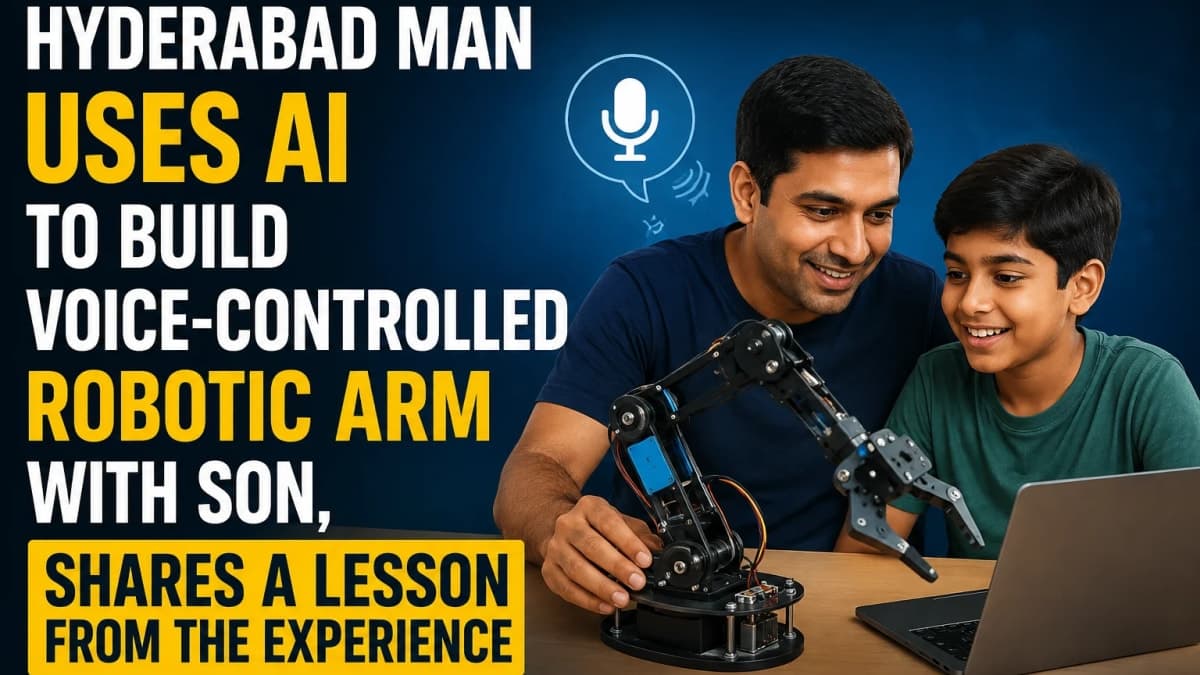
A Hyderabad man has drawn attention after using artificial intelligence while working with his son to build a voice-controlled robotic arm. Beyond the technology itself, the project highlights how AI can become a practical tool for hands-on learning, experimentation and collaboration between parents and children.

Hyderabad Man Uses AI to Build Voice-Controlled Robotic Arm With Son, Shares a Lesson From the Experience
Advertisement

By Jeet Nirmal

Source: India Today Trending Desk

Hyderabad Man Turns AI Into a Hands-On Robotics Project With His Son

Artificial intelligence is increasingly moving beyond chatbots and digital productivity tools into practical, real-world experiments. One such example has emerged from Hyderabad, where a man used AI while working with his son to build a voice-controlled robotic arm.

The father-son project combined artificial intelligence, robotics and voice-based interaction, demonstrating how emerging technology can be used for practical experimentation rather than remaining limited to screens and software.

The man also shared a lesson from the experience, adding a broader learning dimension to what might otherwise have been viewed simply as a technology project.

Voice Commands Meet Robotics

A voice-controlled robotic arm is designed to respond to spoken instructions rather than relying exclusively on conventional physical controls.

Building such a system can involve several areas of technology, including software, electronics, mechanical components and voice-command processing. AI tools can potentially make experimentation more accessible by helping users understand concepts, troubleshoot problems or develop software needed for a prototype.

In this case, the notable aspect is also the collaborative nature of the project. Instead of treating AI as a ready-made solution, the father and son used technology as part of the process of creating something physical.

Why the Project Matters

Generative AI has made technical information and assistance easier to access for people outside traditional engineering environments. Tasks that previously might have required extensive searching through manuals, programming forums and documentation can increasingly be explored with AI-assisted guidance.

That does not eliminate the need to understand how a system works. Robotics projects still require testing, problem-solving and careful integration of hardware and software.

The Hyderabad project therefore reflects an emerging approach to AI: using the technology as an assistant during the learning and building process.

A Different Kind of Parent-Child Learning

The involvement of the man's son gives the project an educational dimension as well.

Hands-on projects can introduce children to concepts such as programming, electronics, robotics and logical problem-solving in a more tangible way than simply reading about them. Building something together can also encourage experimentation, where failures and adjustments become part of the learning process.

AI may lower some initial barriers by making explanations and technical guidance easier to obtain, potentially allowing families, students and hobbyists to attempt projects that once appeared too complicated.

AI Is Helpful, but Human Judgment Still Matters

Projects of this kind also illustrate an important limitation of AI-assisted building.

AI-generated instructions or code are not automatically correct. Suggestions may contain errors, misunderstand technical requirements or overlook safety considerations. Anyone working with electronic or mechanical systems still needs to verify information and test components carefully.

This makes AI most useful as a supporting tool rather than a replacement for human reasoning.

The value of such experiments lies not only in whether the final machine works, but also in understanding why it works, identifying mistakes and learning how to improve it.

From AI Conversations to Physical Creation

The voice-controlled robotic arm offers a small but meaningful example of how artificial intelligence can connect digital assistance with physical creation.

For parents and students, it points toward a potentially valuable way of approaching emerging technology: rather than simply consuming AI-generated content, users can employ AI to explore ideas, develop skills and create tangible projects.

The Hyderabad father-son experiment ultimately stands out because the story is not solely about a robotic arm. It is also about curiosity, collaboration and learning how to use a powerful new technology thoughtfully.


Advertisement

Related

More stories

OLIX Raises $312 Million at $3.3 Billion Valuation as AI Chip Startup Strengthens Leadership

London-based AI semiconductor startup OLIX has secured $312 million in fresh funding at a $3.3 billion valuation as it accelerates development of specialized computing infrastructure for artificial intelligence. The company has also strengthened its leadership with Professor Nick McKeown joining its board.

1 day ago|AI NEWS

OLIX Raises $312 Million at $3.3 Billion Valuation as AI Chip Startup Strengthens Leadership

Mrunal Thakur Issues Strict Warning Against AI Deepfakes: ‘Consider This Your Formal Notice to Stop Immediately’

Bollywood actor Mrunal Thakur has issued a strong warning against people creating or circulating AI-generated deepfake content using her identity. The actor made it clear that unauthorized use of her likeness would not be tolerated and warned that continued misuse could result in legal action. Her intervention comes amid growing concerns over AI-powered impersonation, manipulated images and misleading videos involving public figures.

1 day ago|AI NEWS

Mrunal Thakur Issues Strict Warning Against AI Deepfakes: ‘Consider This Your Formal Notice to Stop Immediately’

OpenAI Says Astra Solved 10 Complex Math Problems; Anthropic Claims Claude Fable Solved Five

OpenAI has claimed that its next-generation AI model, Astra, successfully solved 10 complex mathematics problems, while Anthropic says its Claude Fable model solved five. The reported results highlight the intensifying competition to build artificial intelligence systems capable of handling increasingly difficult reasoning tasks, although the headline facts alone do not establish whether the two performances were measured under identical conditions.

2 days ago|AI NEWS

OpenAI Says Astra Solved 10 Complex Math Problems; Anthropic Claims Claude Fable Solved Five

Snapchat to Stop Recommending Fully AI-Generated Videos on Spotlight, Prioritises Human Creativity

Snapchat is tightening its approach to artificial intelligence-generated content on Spotlight, its short-form video feed. The platform will prioritise authentic, human-created material over videos produced entirely by generative AI, reflecting a broader effort by social platforms to prevent repetitive and low-effort synthetic content from dominating recommendation feeds.

2 days ago|AI NEWS

Snapchat to Stop Recommending Fully AI-Generated Videos on Spotlight, Prioritises Human Creativity

Google Reportedly Had a ChatGPT-Like AI Before OpenAI but Never Released It

Google reportedly developed a conversational artificial intelligence system resembling what later became widely associated with ChatGPT before OpenAI launched its popular chatbot, but chose not to release the technology publicly. The reported revelation raises questions about how early technological leadership, product strategy and willingness to launch experimental AI systems shaped the generative AI race.

2 days ago|AI NEWS

Google Reportedly Had a ChatGPT-Like AI Before OpenAI but Never Released It

Right About AI, Wrong About Leverage: The Fall of Leopold Aschenbrenner’s ‘Situational Awareness’

Leopold Aschenbrenner’s “Situational Awareness” became part of a wider debate over the speed and consequences of artificial intelligence development. But the contrast between being directionally right about AI and potentially wrong about where lasting leverage lies highlights a broader lesson: anticipating technological change is different from accurately predicting who will control, profit from, or shape it.

3 days ago|AI NEWS

Right About AI, Wrong About Leverage: The Fall of Leopold Aschenbrenner’s ‘Situational Awareness’
Advertisement