EU AI Act Goes Live as Europe Tightens Oversight of Artificial Intelligence
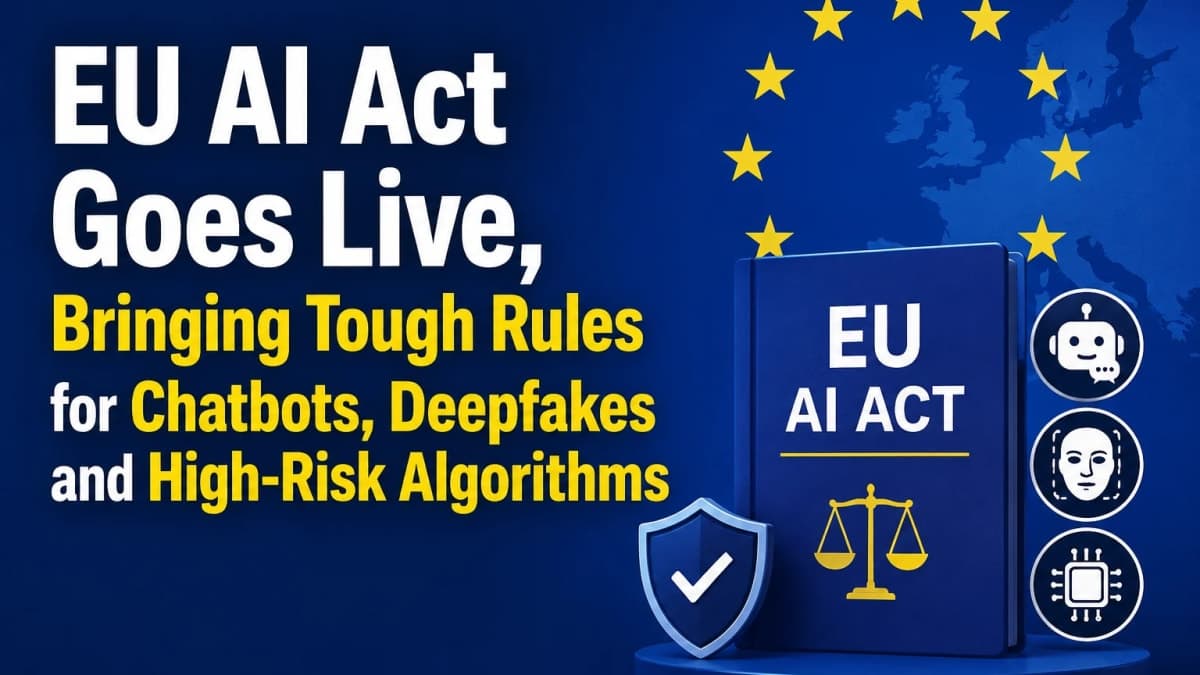
The European Union's landmark AI Act has gone live, bringing a new regulatory framework to artificial intelligence technologies including chatbots, deepfakes and algorithms considered high risk.
The development represents an important moment in the global debate over how governments should regulate increasingly powerful artificial intelligence systems while allowing technological innovation to continue.
With AI tools becoming embedded in communication, business and digital services, European policymakers are moving toward a framework in which different applications can face regulatory requirements according to their potential risks.
Chatbots Come Under Greater Regulatory Attention
Chatbots have rapidly become one of the most visible applications of generative artificial intelligence.
These systems can produce text and interact with users in increasingly sophisticated ways, creating opportunities for businesses and consumers while simultaneously raising questions around transparency, reliability and accountability.
By bringing such technologies within its regulatory framework, the EU is signalling that widespread adoption of AI should be accompanied by clearer responsibilities surrounding its use.
Deepfakes Become a Key Concern
Deepfake technology is another important area covered by the new regulatory environment.
AI systems can generate or manipulate realistic-looking images, audio and video, making it increasingly difficult in some circumstances to distinguish synthetic material from authentic content.
The technology has legitimate applications across entertainment, creative industries and digital production. However, it can also create risks when synthetic content is presented in misleading ways.
Rules addressing deepfakes therefore reflect a wider effort to increase transparency as AI-generated media becomes more convincing and accessible.
High-Risk Algorithms Face Tougher Scrutiny
A central issue surrounding artificial intelligence regulation is how authorities should approach systems capable of affecting consequential decisions.
Algorithms classified as high risk can attract greater regulatory scrutiny because errors or inappropriate use could potentially have a more significant impact on individuals or society.
The EU's approach highlights a broader principle emerging in AI governance: not every artificial intelligence application presents the same level of risk.
A relatively limited AI tool and a system involved in consequential decision-making may therefore require different levels of oversight.
Why the EU AI Act Matters
The significance of the AI Act extends beyond Europe.
Technology companies frequently operate across multiple markets, meaning major regulatory requirements introduced in one large economic region can influence how products and compliance systems are designed elsewhere.
The European Union has previously played an influential role in debates surrounding digital regulation and consumer protection. Its move into comprehensive AI governance could similarly contribute to discussions among governments considering their own approaches to artificial intelligence.
Companies developing AI technologies may consequently need to consider regulatory obligations alongside performance, cost and product development.
Balancing Innovation With Accountability
The central challenge facing AI regulation is finding an appropriate balance between protecting people from potential harms and avoiding unnecessary restrictions on useful innovation.
Supporters of stronger regulation argue that clear standards can increase accountability and public confidence in artificial intelligence.
Businesses and technology developers, however, can face additional compliance requirements as governments introduce more detailed rules. If regulations become excessively complex or burdensome, critics may argue that they could increase costs or make experimentation more difficult.
The effectiveness of the European approach will therefore depend not simply on the existence of the law but also on how its requirements operate as AI technologies continue to evolve.
A New Phase for Global AI Governance
Artificial intelligence is advancing faster than many traditional regulatory systems were designed to handle.
The EU AI Act going live marks a shift from largely theoretical debates about AI regulation toward practical rules governing how certain technologies are developed, deployed and presented.
Chatbots, deepfakes and high-risk algorithms are among the technologies now at the centre of that transition.
As governments, technology companies and users adjust to the rapidly changing AI landscape, Europe's regulatory experiment could become an important reference point in the wider global discussion over how artificial intelligence should be governed.