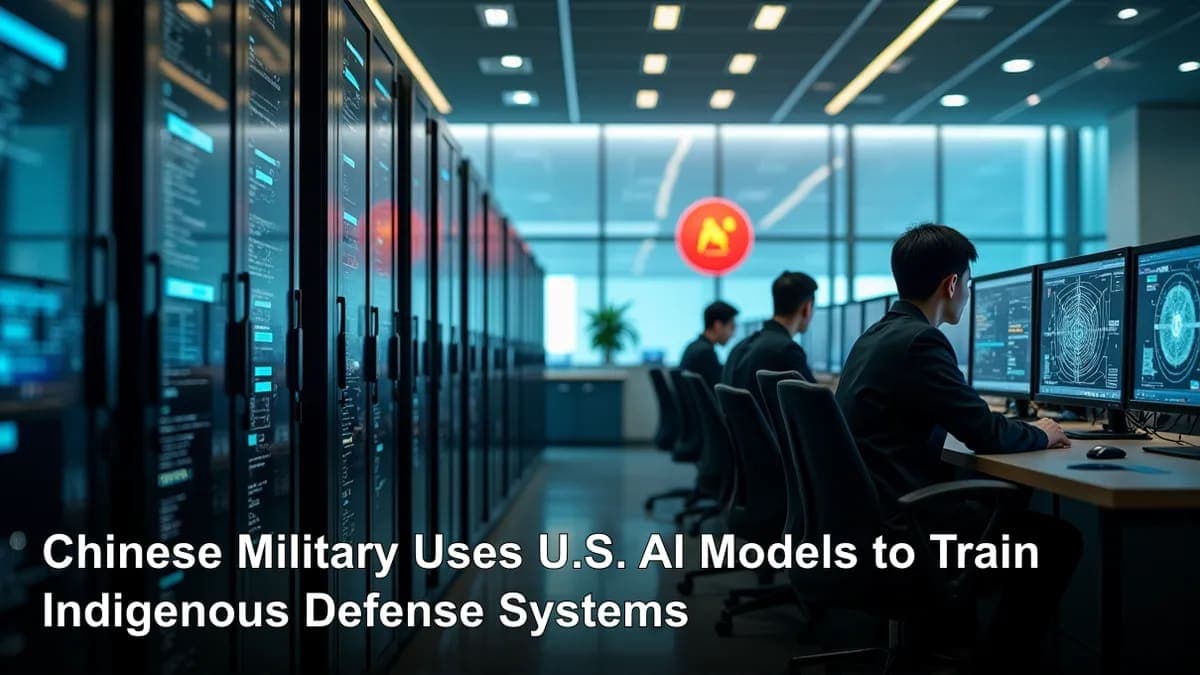
Chinese defence researchers have been tapping the outputs of leading U.S. artificial‑intelligence systems, such as OpenAI’s GPT‑3.5 and Anthropic’s Claude 3 Haiku, to create home‑grown models for military applications, a Reuters investigation disclosed on Monday. The practice, known as model distillation, involves training a compact AI on the responses of a larger, more powerful system, allowing the smaller model to run on edge devices without the massive compute required for original development.
The findings emerged from a review of more than 80 Chinese academic papers and patents, many of which are linked to the People’s Liberation Army (PLA). The documents show that distillation is being employed across a range of defence‑related tasks, from analysing drone video feeds to monitoring social‑media content for security purposes. U.S. officials have warned that such unauthorised extraction could undermine export controls and infringe intellectual‑property rights, while Beijing dismisses the accusations as an attempt at “AI hegemonism.”
What Happened
Researchers affiliated with PLA units and military‑linked universities described using GPT‑3.5 to summarise sensitive source code, then training a Chinese‑origin model on those summaries so it could operate entirely within a closed network. Another study from the North University of China detailed how Anthropic’s Claude 3 Haiku was leveraged to generate synthetic data for a text‑classification system that monitors online content. Both examples illustrate a systematic effort to capture the reasoning patterns of Western models and embed them in domestically controlled AI.
Additional papers revealed that distilled models are being deployed on unmanned aerial vehicles (UAVs) for real‑time image processing, enabling drones to navigate and select targets even when communications are disrupted. A separate effort by the Academy of Military Sciences described a target‑recognition model running on tactical hardware during simulated maritime exercises involving drones, ships and autonomous submarines.
Chinese officials argue that the practice is a legitimate shortcut in the face of U.S. restrictions on high‑end chips and other strategic technologies. They contend that the domestic models are “lightweight” versions that can be securely operated on the PLA’s own infrastructure, reducing reliance on foreign cloud services.
U.S. companies, however, have raised concerns that distilled models may lose the safety safeguards built into the original systems. Anthropic noted that its policy‑monitoring tools are not designed for deployment in China and that the loss of safety layers could allow capabilities to be transferred beyond its control.
Background
Model distillation is an established technique in machine‑learning research, allowing developers to compress a large “teacher” model into a smaller “student” model that retains selected capabilities. The method gained prominence as AI models grew to billions of parameters, making full‑scale training prohibitively expensive for many organisations. In the geopolitical arena, the practice has become a flashpoint as the United States tightens export controls on advanced semiconductors and AI‑related software.
Timeline
2023 – U.S. begins expanding export restrictions on high‑performance GPUs and AI accelerators.
Early 2024 – PLA‑linked papers start mentioning the use of GPT‑3.5 for code summarisation.
Mid‑2024 – Anthropic’s Claude 3 Haiku cited in Chinese research on synthetic data generation.
Late 2024 – National University of Defense Technology publishes a study on distilling image‑processing models for UAVs.
January 2025 – Chinese Army Engineering University releases a paper on “data‑free distillation” as a potential security threat.
July 2026 – Reuters releases the current investigation, highlighting over 80 papers and patents.
The rapid emergence of these papers coincides with Beijing’s broader push for “model lightweighting” and edge‑computing capabilities, backed by government subsidies and research grants aimed at reducing dependence on foreign compute infrastructure.
Why It Matters
For U.S. policymakers, the reports underscore a loophole in current export‑control regimes: while physical chips can be barred from export, the intellectual output of AI models can still be harvested through cloud‑based APIs. If Chinese militaries can reliably replicate critical reasoning abilities in locally hosted models, the strategic advantage offered by frontier AI could erode faster than anticipated.
From a security perspective, distilled models may lack the robust alignment and safety mechanisms embedded in their parent systems. This could lead to unpredictable behaviour when the models are repurposed for surveillance, autonomous weaponry, or cyber‑offensive tools, raising the risk of accidental escalation.
For the commercial AI sector, the episode highlights the tension between open‑access research models and the need to protect proprietary technology. Companies may need to reconsider how they expose model outputs to foreign users, potentially tightening API monitoring or restricting access to certain regions.
Industry Impact
The revelation is likely to accelerate discussions in both Washington and Beijing about how to define “use” of AI models under export‑control law. Legislators may push for tighter restrictions on API‑based services, while Chinese regulators could double‑down on domestic AI development to achieve self‑sufficiency.
Analysis
Experts note that distillation does not eliminate the need for substantial compute; it merely shifts the heavy‑lifting to the original model’s provider. Consequently, the United States retains a strategic edge as long as its models remain the most capable teachers. However, the growing ecosystem of distilled models could create a “second‑generation” AI capability that is harder to track and regulate, complicating attribution in cyber‑conflict scenarios.
Key Takeaways
Chinese military researchers are systematically distilling U.S. AI models to create smaller, locally deployable systems.
Distillation enables capabilities such as code summarisation, social‑media monitoring, and real‑time drone image analysis.
The practice skirts existing export‑control measures that focus on hardware rather than model outputs.
Distilled models may lose safety safeguards, raising concerns about uncontrolled deployment in defence contexts.
U.S. firms risk intellectual‑property loss while Chinese authorities view the technique as a shortcut to AI parity.
Policy debates are expected to intensify around API access, data‑free distillation threats, and the definition of “technology transfer.”
Conclusion
As the United States prepares for its next round of AI‑governance talks with Beijing, the evidence of widespread model distillation by PLA‑linked institutions adds urgency to calls for clearer rules on AI export controls. Observers will watch for any regulatory response from both sides, as well as for signs that Chinese defence agencies can achieve operational independence from foreign AI models.
Future research is likely to focus on detecting distilled model footprints and developing counter‑measures that protect the proprietary knowledge embedded in frontier AI systems. The coming months may therefore see a tightening of API access policies and a renewed emphasis on domestic AI compute capabilities in both Washington and Beijing.