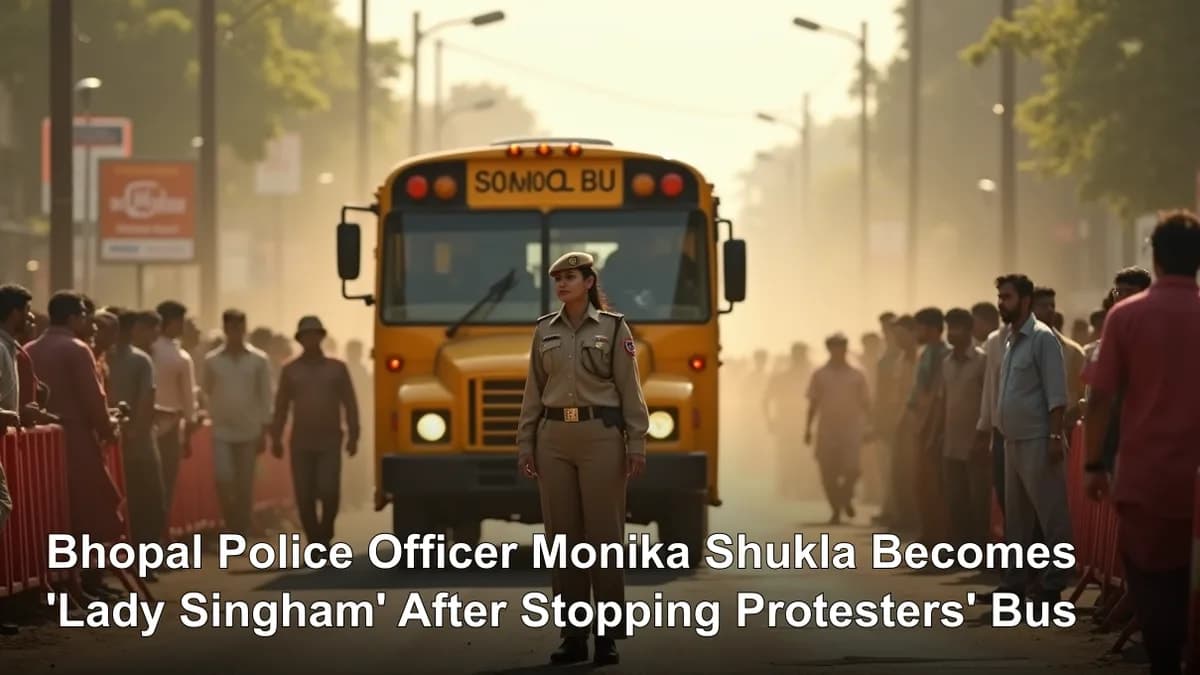
On July 30, 2026, a video of Assistant Commissioner of Police (Traffic and Crime) Monika Shukla standing in front of a moving bus went viral on social media. The incident unfolded in Bhopal, Madhya Pradesh, as a large group of protesting farmers attempted to push a bus off the road while marching toward the state chief minister’s residence. Shukla’s quick decision to block the vehicle earned her the nickname “Lady Singham,” a reference to the fictional Indian police hero known for fearless action.
In an interview with NDTV, Shukla described the episode as a routine fulfillment of duty, emphasizing that she acted on instinct to prevent the bus from being forced forward. Her calm demeanor and willingness to place herself in harm’s way sparked widespread applause online, with the clip rapidly accumulating millions of views across platforms.
What Happened
According to the officer, police had positioned school buses along the protest route to serve as a temporary barricade, a tactic intended to channel the demonstrators away from the city centre. When the farmers began to push against the barricade, one of the buses started to move forward, threatening to breach the cordon and enter the capital. Shukla, who was stationed nearby, stepped directly in front of the moving vehicle, signaling to the crowd that the police would not allow the bus to proceed.
The visual of a senior police official physically interposing herself between a heavy vehicle and a mass of protesters caused the crowd to pause. Within moments, the farmers backed away from the bus, allowing the police to regain control of the situation without further escalation. Shukla later told NDTV that she felt no fear, describing the act as “nothing extraordinary” given her extensive experience in managing law‑and‑order scenarios.
She also stressed that the protesters were not criminals but citizens exercising their constitutional right to demand redress. While acknowledging the possibility of “anti‑social elements” infiltrating the march, Shukla reiterated the police’s responsibility to maintain restraint and protect public safety. Her remarks underscored a broader policy stance that law‑enforcement agencies should balance firmness with empathy during civil unrest.
Background
Farmer protests have been a recurring feature of Indian politics, especially in states such as Madhya Pradesh where agricultural distress remains high. In recent months, a coalition of farmer groups has been marching toward the capital of Bhopal to press for better loan waivers, price guarantees, and water‑management reforms. The protests have largely been peaceful, but occasional flashpoints have emerged when demonstrators attempt to breach police‑set barriers.
Earlier in the same week, a separate video of a female protester standing in front of a police van went viral, highlighting the heightened emotions on both sides of the standoff. That clip set the stage for Shukla’s own footage to capture public imagination, as both videos featured women confronting authority in high‑tension moments.
Timeline
Early July 2026 – Farmer groups begin organized march toward Bhopal’s chief minister residence.
Mid‑July 2026 – Police deploy school buses as temporary barricades along the protest route.
July 28, 2026 – Video of a female protester standing before a police van circulates online.
July 30, 2026 – Monika Shukla blocks a moving bus; video goes viral.
August 1, 2026 – NDTV publishes exclusive interview with Shukla.
Why It Matters
The incident shines a spotlight on how individual actions by law‑enforcement officials can shape public perception of protest management. Shukla’s willingness to physically intervene, rather than rely solely on crowd‑control equipment, resonated with many citizens who view such gestures as a sign of personal bravery and commitment to duty.
At the same time, her remarks about restraint and the non‑criminal status of protesters contribute to an ongoing debate about the appropriate balance between maintaining order and respecting democratic rights. In a country where police responses to demonstrations have sometimes been criticized for excessive force, Shukla’s approach offers a contrasting narrative that could influence future policing protocols.
Social media amplification also means that isolated incidents quickly become symbols. The “Lady Singham” moniker, for instance, frames Shukla within a cultural archetype of the incorruptible, fearless officer, potentially affecting recruitment, morale, and public trust in the police force.
Industry Impact
From a law‑enforcement perspective, the episode may prompt other state police departments to reassess the use of physical presence versus technological crowd‑control tools such as water cannons or drones. The visual impact of a senior officer placing herself in harm’s way could encourage a more hands‑on approach, especially in regions where community relations are fragile.
Media organisations are also likely to monitor the virality of such footage, recognizing the power of short, dramatic clips to drive audience engagement. Newsrooms may allocate more resources to real‑time verification and contextual reporting of protest‑related videos, aiming to balance speed with accuracy.
Key Takeaways
Monika Shukla, an Assistant Commissioner of Police in Bhopal, stopped a moving bus during a farmer protest on July 30, 2026.
The act, captured on video, earned her the nickname “Lady Singham” and sparked widespread online praise.
Shukla emphasized police restraint, stating that protesters are citizens exercising democratic rights.
The incident highlights the role of individual police actions in shaping public narratives around protest management.
Social media amplification turns isolated moments into national symbols, influencing both public perception and policing strategies.
Conclusion
As farmer protests continue across Madhya Pradesh, the Bhopal episode serves as a reminder that on‑ground decisions by police leaders can have outsized symbolic impact. Observers will watch whether Shukla’s example prompts a broader shift toward measured, physically present policing in India’s democratic protests.
Future developments, including any policy revisions or training initiatives inspired by the incident, will be crucial in determining how law‑enforcement agencies balance firmness with the constitutional right to peaceful assembly.