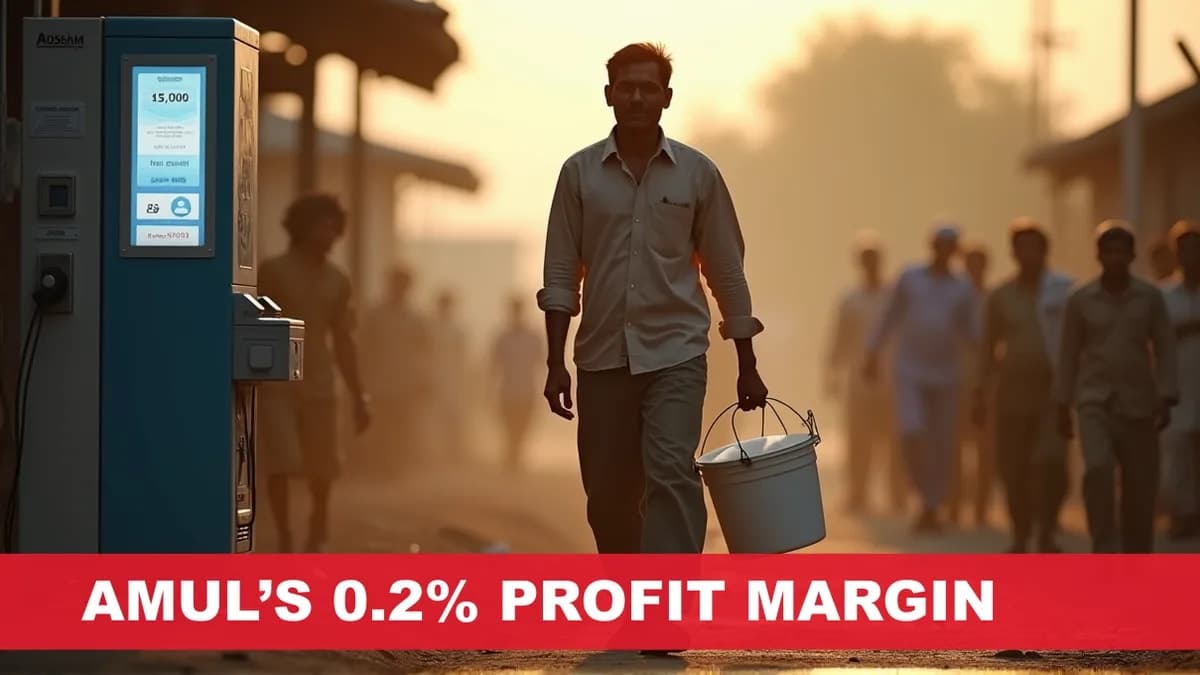
In the early hours of a Gujarat dawn, a woman carries a bucket of milk to a village collection centre where a machine checks its fat content, prints a slip, and credits her account. The woman owns two animals, but she is part of a network that feeds the 1 lakh crore‑rupee Amul brand that supplies milk to 36 lakh farmers across 18,000 societies. Amul’s parent, GCMMF, posted a 0.2% profit margin on Rs 59,286 crore of revenue in FY24, a figure that would be a red flag for any listed company, yet CARE Ratings awarded it a AAA rating in May 2025.
Amul’s financial story is not one of high margins or aggressive growth but of a deliberate, farmer‑centric distribution of profits. The cooperative’s structure eliminates the classic conflict between suppliers and shareholders, allowing the company to keep only enough to cover costs while passing the rest back to the farmers who own it.
What Happened
GCMMF, the marketing arm of the Amul cooperative, reported revenue of Rs 59,286 crore in FY24 and a net profit of Rs 123 crore, translating to a razor‑thin margin of 0.2%. The company’s share of the market varies by product, ranging from 40% to 85% in different categories, and its milk pouch pricing is the benchmark for the country.
Despite the low margin, CARE Ratings assessed GCMMF’s financial health as strong, citing the cooperative’s unique ownership structure as a source of credit strength. The rating agency noted that the cooperative’s purpose is to pass the maximum price to its farmer members, retaining only what is necessary for debt servicing, capital expenditures, and operating expenses.
Amul’s pricing model involves a two‑step process: an interim rate is paid to district milk unions throughout the year, and a final settlement is made at year‑end after bills are covered. The surplus is then distributed back to the farmers. Amul claims that 80%–85% of every consumer rupee flows back to farmers, a figure that is self‑reported and not independently audited.
Background
The cooperative’s foundation dates to 1946, when the Anand Pattern was conceived in the city of Anand, Gujarat. Amul operates through a three‑tiered structure: village dairy societies at the base, 18 district milk unions in 33 districts of Gujarat, and GCMMF at the apex. Over 36.4 lakh farmers contribute milk through more than 18,000 societies. Every farmer holds one vote, regardless of the volume of milk they supply, ensuring that ownership and control are evenly distributed.
Why It Matters
Amul’s model demonstrates how a cooperative can sustain a large consumer brand without sacrificing farmer welfare. The thin margin is a deliberate choice that prioritises supply stability over shareholder returns. By ensuring that farmers receive the bulk of consumer revenue, Amul secures a reliable supply chain that resists market volatility.
The cooperative’s success also challenges conventional business assumptions. In a typical dairy, farmers demand higher prices while shareholders push for lower costs. Amul eliminates this conflict because the farmers are also the shareholders, so the company can afford to keep profits low while maintaining high farmer satisfaction.
For consumers, Amul’s pricing stability translates into consistent product quality and availability across more than 50 countries. The cooperative’s scale—processing 31 to 35 million litres of milk daily—supports a vast network of 50+ products, 1,200 SKUs, and 20 lakh retailers.
Industry Impact
Amul’s model sets a benchmark for cooperatives worldwide, especially in emerging markets where smallholder farmers dominate the supply chain. The company’s ability to maintain a 1 lakh crore brand turnover while keeping profit margins at 0.2% shows that cooperatives can compete with private firms without compromising farmer welfare.
Analysis
Regulators and investors may view Amul’s structure as a risk factor, but CARE Ratings’ AAA assessment indicates that the cooperative’s financial stability is robust. The model’s reliance on farmer ownership shields the company from the typical pressures of public markets and allows it to focus on long‑term supply security.
Key Takeaways
Amul’s profit margin sits at 0.2% on revenue of Rs 59,286 crore.
CARE Ratings awarded GCMMF a AAA rating, citing the cooperative structure as credit strength.
The cooperative passes 80%–85% of consumer revenue back to farmers, a self‑reported figure.
Amul’s model eliminates the supplier‑shareholder conflict, enabling a stable supply chain.
In FY25‑26, Amul reached Rs 1 lakh crore in un‑duplicated brand turnover, the first Indian FMCG brand to do so.
Conclusion
Amul’s cooperative model proves that a business can thrive on a thin margin if the ownership structure aligns the interests of suppliers and shareholders. As the dairy industry faces rising costs and supply challenges, Amul’s approach offers a blueprint for balancing profitability with farmer welfare. Stakeholders will watch closely to see whether other cooperatives adopt similar practices and how Amul’s strategy evolves in the face of global market pressures.